
Compound Interest
Compound Interest Calculator
Compound Interest Calculator – Calculate Future Value of Your Investment (2026 Guide)
Saving money is good, but growing money is even better. If you want to build wealth, plan your future, or calculate how much your investment will become after a few years, then a Compound Interest Calculator is one of the best tools you can use.
Compound interest is often called the 8th wonder of the world because it helps your money grow faster over time. Unlike simple interest, compound interest adds interest on both the principal amount and the previously earned interest, which creates exponential growth.
In this complete SEO guide, you will learn:
- What compound interest is
- How compound interest works
- Compound interest formula
- How to use a compound interest calculator
- Examples for better understanding
- Difference between simple and compound interest
- FAQs for students and investors
What is Compound Interest?
Compound interest is interest calculated on the initial principal plus the interest that has already been added to the investment.
In simple words:
👉 Compound interest = Interest on interest
This means your money grows faster because the interest earned is reinvested and starts generating more interest.
Example (Simple Explanation)
If you invest ₹10,000 at 10% interest:
- Year 1 interest = ₹1,000
- Total after Year 1 = ₹11,000
Now, in Year 2, interest is calculated on ₹11,000, not ₹10,000.
That is compound interest.
Why Compound Interest is Important?
Compound interest is important because it:
- Helps grow wealth faster
- Encourages long-term investment
- Works best when time period is longer
- Is useful for retirement planning
- Helps calculate investment returns accurately
Whether you are investing in fixed deposits, mutual funds, stocks, PPF, or SIP, compound interest plays a big role in calculating your returns.
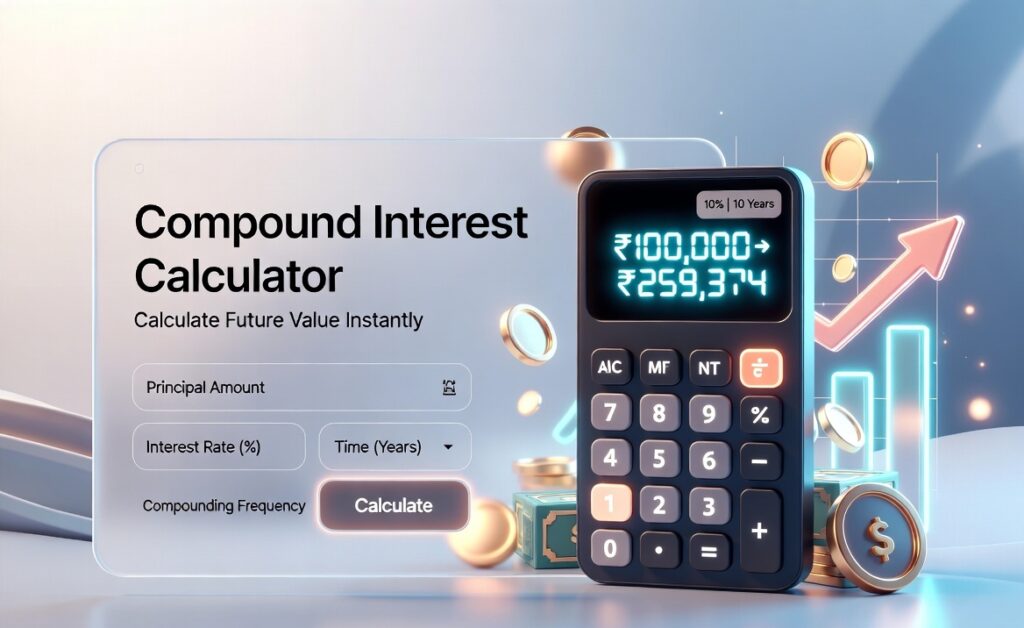
What is a Compound Interest Calculator?
A Compound Interest Calculator is an online tool that helps you calculate:
✅ Final amount after interest
✅ Total interest earned
✅ Growth of investment over time
✅ Future value of savings
It considers:
- Principal amount (initial investment)
- Interest rate
- Time period
- Compounding frequency (monthly, yearly, quarterly, etc.)
Instead of doing complex calculations manually, this calculator gives results instantly.
Compound Interest Formula
The standard compound interest formula is:
A = P (1 + r/n)^(nt)
Where:
- A = Final amount (future value)
- P = Principal amount (initial investment)
- r = Interest rate (in decimal form)
- n = Number of times interest is compounded per year
- t = Time (in years)
Compound Interest (CI) Formula:
CI = A – P
Understanding Compound Interest Formula (Easy Breakdown)
Let’s understand the formula in a simple way:
- (1 + r/n) means the interest is added in parts depending on compounding frequency
- (nt) means total number of compounding periods
If interest is compounded monthly:
- n = 12
If interest is compounded quarterly:
- n = 4
If interest is compounded yearly:
- n = 1
The more frequently it compounds, the higher the final amount becomes.
How to Use a Compound Interest Calculator?
Using a compound interest calculator is very simple.
Step-by-Step Guide:
Step 1: Enter Principal Amount
This is the amount you invest initially.
Example: ₹50,000
Step 2: Enter Interest Rate
Enter annual interest rate.
Example: 10%
Step 3: Enter Time Period
Enter number of years.
Example: 5 years
Step 4: Choose Compounding Frequency
Select compounding type such as:
- Yearly
- Half-yearly
- Quarterly
- Monthly
- Daily
Step 5: Click Calculate
The calculator will show:
- Total amount after interest
- Total interest earned
Compound Interest Example (Yearly Compounding)
Let’s take a simple example:
- Principal (P) = ₹10,000
- Rate (r) = 10%
- Time (t) = 3 years
- Compounding = yearly (n = 1)
Calculation:
A = 10000 (1 + 0.10/1)^(1×3)
A = 10000 (1.10)^3
A = 10000 × 1.331
A = ₹13,310
Compound Interest:
CI = 13,310 – 10,000
CI = ₹3,310
So after 3 years, your investment becomes ₹13,310.
Compound Interest Example (Monthly Compounding)
Now same values, but compounded monthly:
- P = ₹10,000
- r = 10%
- t = 3
- n = 12
A = 10000 (1 + 0.10/12)^(12×3)
A = 10000 (1.008333)^(36)
A ≈ ₹13,489
So monthly compounding gives more than yearly.
Difference Between Simple Interest and Compound Interest
Many people confuse simple interest with compound interest. Both are different.
Simple Interest
Simple interest is calculated only on the principal amount.
Formula:
SI = (P × R × T) / 100
Interest stays the same every year.
Compound Interest
Compound interest is calculated on principal + previously earned interest.
Interest increases every year.
Comparison Table
| Feature | Simple Interest | Compound Interest |
|---|---|---|
| Interest calculation | Only on principal | On principal + interest |
| Growth speed | Slow | Fast |
| Best for | Short-term loans | Long-term investments |
| Used in | Some loans | Investments, FD, SIP |
Why Compound Interest is Better for Investors?
Compound interest is better because it increases your wealth faster. It works best when you invest early and remain invested for long periods.
Example:
If you invest ₹1,00,000 at 12% for 20 years:
- With simple interest, growth is linear
- With compound interest, growth is exponential
This is why compound interest is extremely powerful for long-term investors.
Compound Interest Growth Over Time
Compound interest grows slowly in the beginning but increases rapidly later.
Growth Pattern:
- First 5 years: slow growth
- Next 10 years: medium growth
- After 15+ years: huge growth
This is why long-term investment is important.
What is Compounding Frequency?
Compounding frequency means how often the interest is added to the principal.
Common compounding options:
- Annually (Yearly)
- Semi-Annually (Half-yearly)
- Quarterly
- Monthly
- Daily
Important Point:
More frequent compounding results in higher returns.
Types of Compound Interest Compounding
1. Annual Compounding
Interest added once per year.
2. Quarterly Compounding
Interest added 4 times a year.
3. Monthly Compounding
Interest added 12 times a year.
4. Daily Compounding
Interest added 365 times a year.
Daily compounding provides maximum growth but difference is small compared to monthly for normal interest rates.
Compound Interest Calculator for SIP (Monthly Investment)
Many investors use SIP (Systematic Investment Plan). SIP is based on compound growth.
In SIP:
- You invest monthly
- Returns are compounded
- Final value becomes much higher over time
A compound interest calculator helps you estimate how much money you will have after 10, 15, or 20 years.
Compound Interest Calculator for Fixed Deposit (FD)
Fixed deposits are popular in India and most banks offer compound interest in FD.
Banks usually compound FD interest:
- Quarterly
- Monthly
- Yearly
So FD returns depend on compounding frequency.
A compound interest calculator can help you compare:
- FD in Bank A vs Bank B
- Monthly vs quarterly compounding
- Different interest rates
Compound Interest Calculator for Savings Account
Some banks offer compound interest in savings accounts, usually compounded:
- Quarterly
- Monthly
If you keep money in a savings account, your interest grows with compounding.
Compound Interest Calculator for Loan Planning
Compound interest is not always beneficial. It can work against you in loans.
Loans like:
- Credit card loans
- Personal loans
- Home loans (sometimes)
may involve compounding interest.
A compound interest calculator helps you understand:
- How much interest you will pay
- How your debt increases if you delay payment
Compound Interest in Real Life
Compound interest is used in:
- Fixed deposits
- Mutual funds
- PPF and NPS
- Retirement funds
- Bonds
- Recurring deposits
- Loan interest calculations
- Credit card payments
That’s why understanding compound interest is very important for financial planning.
Advantages of Compound Interest
Compound interest has many benefits:
1. Faster Wealth Growth
Your investment increases faster over time.
2. Best for Long-Term Investors
The longer you stay invested, the bigger the returns.
3. Automatic Reinvestment
Interest earned becomes part of the principal.
4. Helps in Retirement Planning
Even small investments can become huge after 20-30 years.
5. Encourages Early Investment
The earlier you invest, the better the results.
Disadvantages of Compound Interest
Compound interest also has disadvantages in loans.
1. Debt Can Grow Quickly
If you borrow money with compound interest, the payable amount increases rapidly.
2. Harder to Calculate Manually
The formula includes powers and compounding frequency.
That’s why calculators are useful.
Best Tips to Get Maximum Benefit from Compound Interest
If you want to use compound interest to grow wealth, follow these tips:
Start Investing Early
Even a 5-year early start can double your wealth.
Invest for Long-Term
Compound interest works best over 10+ years.
Choose Higher Compounding Frequency
Monthly or quarterly compounding provides higher returns.
Reinvest Returns
Never withdraw profits early.
Increase Investment Amount
More principal = more compounding benefit.
Compound Interest Calculator – Practical Examples
Example 1: Small Investment Growth
Principal: ₹20,000
Rate: 8%
Time: 5 years
Compounding: yearly
Final amount becomes approximately ₹29,386.
Example 2: Long-Term Wealth Example
Principal: ₹1,00,000
Rate: 12%
Time: 15 years
Final amount becomes approximately ₹5,47,000+.
This shows the real power of compound interest.
Example 3: Retirement Planning Example
Principal: ₹5,00,000
Rate: 10%
Time: 20 years
Final amount becomes approximately ₹33,63,750.
Rule of 72 (Quick Compound Interest Trick)
The Rule of 72 is a shortcut to calculate how fast your money will double.
Formula:
72 ÷ interest rate = years to double
Example:
If rate = 8%
72 ÷ 8 = 9 years
So your money will double in approximately 9 years at 8% interest.
This is not exact but gives a good estimate.
Compound Interest Calculator for Students
Students can use compound interest calculators for:
- Understanding mathematics
- Learning finance
- Preparing for exams
- Planning savings
- Practicing interest formulas
It is also useful for competitive exams like banking exams.
Compound Interest Calculator for Business Owners
Business owners can use compound interest calculations to:
- Estimate investment returns
- Calculate business loan interest
- Plan long-term savings
- Understand future value of funds
Compound Interest vs Inflation
Even though compound interest increases money, inflation reduces purchasing power.
Example:
If you earn 7% interest but inflation is 6%, real gain is only 1%.
So always choose investment options that beat inflation.
Compound Interest Calculator Benefits
Using a compound interest calculator provides:
✅ Instant results
✅ Accurate calculations
✅ Time-saving
✅ No manual formula needed
✅ Useful for investment comparison
✅ Works on mobile and desktop
It is perfect for beginners and professionals.
Frequently Asked Questions (FAQs)
1. What is compound interest in simple words?
Compound interest means interest is calculated on both principal and previous interest.
2. What is the formula for compound interest?
The formula is:
A = P (1 + r/n)^(nt)
Compound Interest = A – P
3. Is compound interest good or bad?
Compound interest is good for investments but bad for loans if payments are delayed.
4. Which is better: simple interest or compound interest?
Compound interest is better for investors because it grows money faster.
5. How often is interest compounded?
It depends on the investment type. Common compounding is monthly, quarterly, or yearly.
6. What is the best example of compound interest?
Mutual funds, SIP, fixed deposits, PPF, and retirement funds are common examples.
7. Can compound interest make you rich?
Yes, but only if you invest early, invest consistently, and stay invested for long-term.
8. What is the rule of 72?
Rule of 72 is a shortcut to estimate how many years it takes to double your money.
9. How can I calculate compound interest online?
You can use an online compound interest calculator by entering principal, rate, time, and compounding frequency.
10. Is compound interest calculated monthly or yearly?
It can be calculated monthly, quarterly, or yearly depending on the investment plan.
Conclusion
A Compound Interest Calculator is a powerful financial tool that helps you estimate the future value of your investments. It makes calculations easy by considering the principal amount, interest rate, time period, and compounding frequency.
Compound interest is one of the most important concepts for building long-term wealth. Whether you are investing in fixed deposits, mutual funds, SIPs, or retirement plans, compound interest plays a major role in your future returns.
If you want to grow your money faster, start investing early and let compound interest do the magic.